

On this page
- What you need to know now
- Classify the institution and each type of fee
- Separate zero-rating, exemption and standard rating
- Match input costs to the activities they support
- Maintain controls across academic and finance teams
- A practical way forward
- Frequently asked questions
- Official sources & further reading
What you need to know now
Education VAT treatment depends on the institution, course and particular supply. Use the FTA’s June 2026 education guide for the current analysis.
- Separate tuition from devices, meals and other supplies.
- Check the conditions for any zero-rating claim.
- Mixed taxable and exempt activities affect input-tax recovery.
Classify the institution and each type of fee
Higher education is not a single VAT category covering every university receipt. The institution, recognised programme and particular supply need to be considered together. Tuition, accommodation, devices, meals, transport and services to third parties may require different conclusions. Use the current FTA Education Sector guide rather than treating the 2020 bulletin as the final reference.
Create a fee matrix with one row for each charge. Identify who supplies it, who pays it and the contractual basis. This makes it easier to detect where a new programme or commercial activity has been added without a corresponding review of its VAT treatment.
Separate zero-rating, exemption and standard rating
Zero-rated and exempt are not alternative labels for the same result. Both may mean no VAT is charged to a particular customer, but the classification can affect the treatment of related input tax. A fee should therefore be coded using the correct legal category, not simply an accounting code called no VAT.
For example, a course fee and a separately sold laptop should not automatically inherit the same tax code. The practical review should consider whether each item is a distinct supply or part of a wider arrangement. Keep the reasoning and representative enrolment documents with the fee matrix.
Match input costs to the activities they support
Review direct costs before allocating shared expenditure. A cost relating entirely to one activity needs a different assessment from a campus overhead used by several departments. Recovery also depends on evidence and any specific restriction; the fact that a university incurred a cost does not establish a right to claim all of its VAT.
Useful workpapers connect purchase invoices to departments, programmes and income streams. When a project changes purpose, explain whether the original allocation remains appropriate. This is particularly relevant for shared facilities, events, commercial research and other activities that may sit alongside the main teaching operation.
Maintain controls across academic and finance teams
New programmes and student packages are often designed outside the finance department. Include a VAT review in the approval process before fees are advertised or the billing system is configured. Finance should receive the final prospectus, contract terms and list of included items rather than an informal description of the package.
At period end, reconcile the student billing system, general ledger and VAT workpaper. Investigate refunds, bursaries, cancellations and credit notes using the underlying arrangement. A documented process reduces inconsistent treatment between similar students and helps explain the institution’s position during a later review.
YOUR NEXT STEPS
A practical way forward
- 01
Step 1
Identify the supplier and recognised programme.
- 02
Step 2
Map each fee and ancillary service separately.
- 03
Step 3
Review input VAT allocation and supporting evidence.
CLEAR ANSWERS
Frequently asked questions
Are all university fees zero-rated?
No. The relevant conditions matter.
Does zero-rated mean exempt?
No. They have different VAT and recovery consequences.
Earlier article & background First published 15 September 2020 · retained for context
This earlier article is preserved for context. Its rates, deadlines, approvals and announcements may have been superseded. Use the current guidance and official references on this page for your next step.
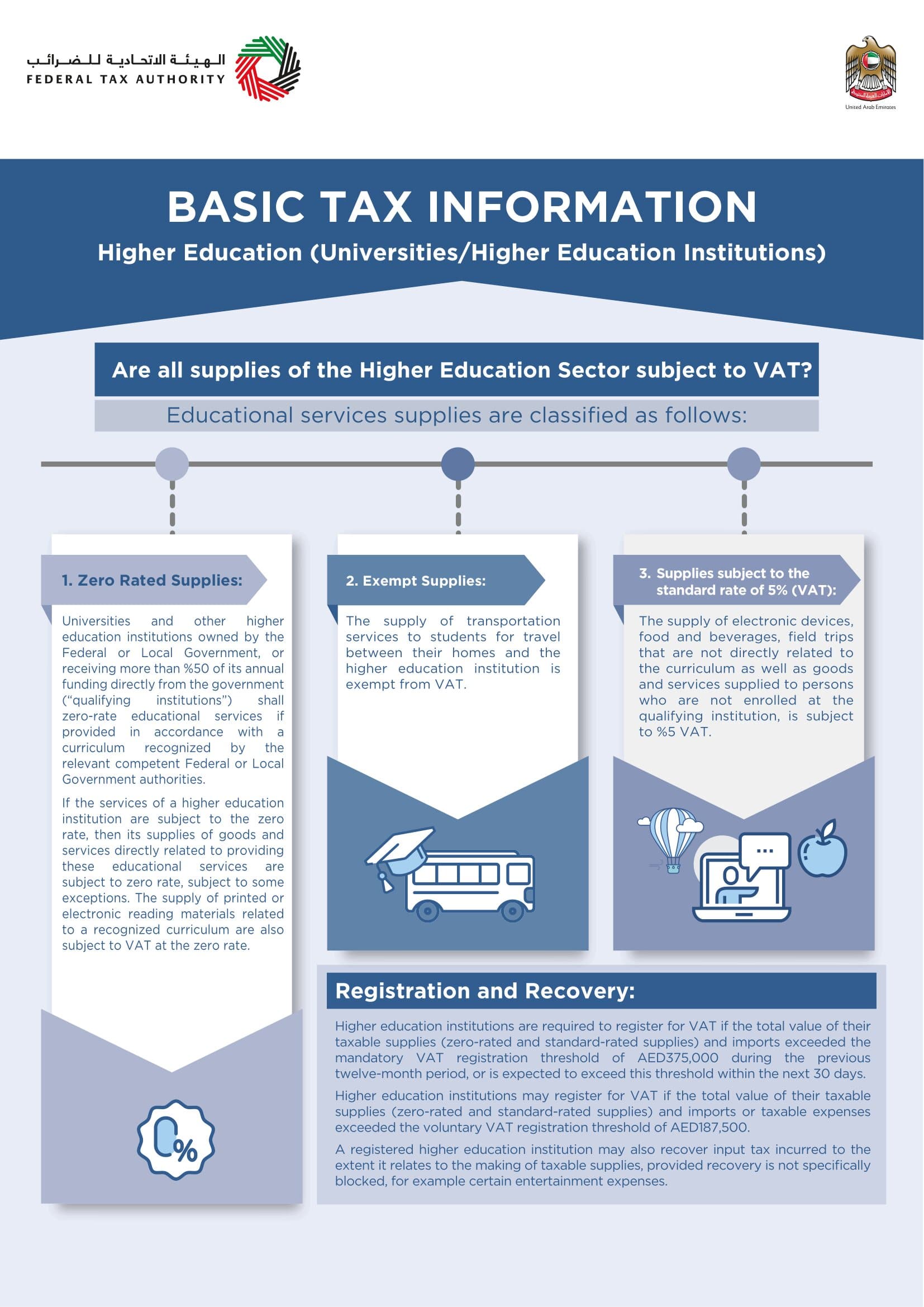
VAT Updates on Higher Education Sector: Basic Tax Information Bulletin Higher Education Sector
VAT Updates on Higher Education Sector
Higher educational institutions can claim VAT refund. These institutions can recover input taxes if they are not in the blocked category. The Federal Tax Authority (FTA), has confirmed that higher educational institutions making only zero-rated and/or standard-rated supplies may recover input tax in full, except where recovery is specifically blocked. Blocked input tax includes value-added tax (VAT) incurred on certain entertainment services, and motor vehicles that have been purchased, leased, or rented and made available for personal use.
The Authority noted that higher education institutions providing exempt supplies are eligible to recover only a portion of the input tax incurred.
The FTA’s Basic Tax Information Bulletin focuses on the tax treatment for the higher education sector in respect of universities and higher education institutions recognized by the competent federal or local government entity regulating the higher education sector where the course is delivered.
Moreover, these higher education institutions may obtain zero-rate educational services supplied in accordance with a curriculum recognized by the competent federal or local government entity, provided the institution is either owned by the federal or local government or receives more than 50 percent of its annual funding directly from the federal or local government (qualifying institution). The bulletin noted that the supply of printed and digital reading material related to an approved curriculum shall be subject to the zero-rate if the supplier is a qualifying institution.
The bulletin also noted that the transportation of students from home to the location of the higher education institution, and vice versa, is exempted from tax and that services supplied to persons who are not enrolled in the higher education institution are subject to 5 percent VAT. The supply of electronic devices, food and beverages, field trips that are not directly related to the curriculum, and other supplies, are also subject to 5 percent VAT.
The bulletin added that higher education institutions providing zero-rated and standard-rated supplies are required to register for VAT if the value of these taxable supplies and imports exceeded the mandatory registration threshold of Dh 375,000 during the last 12 months, or is expected to exceed this threshold within the next 30 days. These institutions are, therefore, required to issue tax invoices.
The bulletin is made available through the FTA website
Courtesy: Gulf News
VERIFY THE DETAIL
Official sources & further reading
Source checks support this general guide. Your treatment depends on the facts, tax period and applicable legislation.